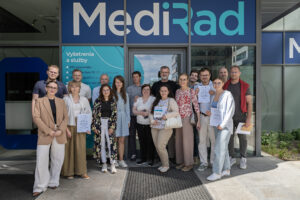
Medirad and Medissim Academy have brought a specialized series of musculoskeletal ultrasound courses to Bratislava.

In May and June 2026, a specialized series of musculoskeletal ultrasound courses took place at the new MediRad clinic on Plynárenská Street in Bratislava. The basic and advanced modules combined theoretical knowledge with practical training, offering participants an intensive educational program led by experienced experts.
The Musculoskeletal Ultrasound course series confirmed that high-quality medical education today must rest on two pillars: professional content and the ability to apply knowledge directly in practice. This principle underpinned both the basic course on May 16, 2026, and the advanced course on June 13, 2026, which provided a comprehensive overview of sonographic diagnosis of the musculoskeletal system in Bratislava.
The basic course covered the technical aspects of USG imaging and basic device operation. The program then focused on the examination of the hips, groins, and ankle joints, as well as the upper and lower extremities, with several blocks structured in a theory + practical training format. The professional content was led by MUDr. Vladimír Neuschl, PhD., MUDr. Péter Bábel and MUDr. Alexandra Uhrinová, providing the program with a clear clinical and educational framework.

The advanced course built on this line with even greater focus. It concentrated on USG correlations and traumatic conditions, the upper and lower extremities in the context of injury diagnoses, apophyseal injuries in children, case studies, and peripheral nerve imaging. This offered participants an expanded perspective on more complex clinical situations and demonstrated how ultrasound can be an effective tool for rapid diagnostic orientation.
A key strength of the entire series was that it did not remain solely theoretical. The program repeatedly incorporated practical training, continuous education, and concluded with the awarding of diplomas, feedback, and a quiz. This structured approach to education is important not only for professionals but also indirectly for the general public, as the quality of continuous medical education translates into more accurate and confident diagnosis for patients with musculoskeletal problems.